Local SEO at a Glance
Customers searching for a nearby business are rarely browsing without purpose.
They are looking for a service, comparing local providers and deciding who they trust enough to call, visit, book or contact.
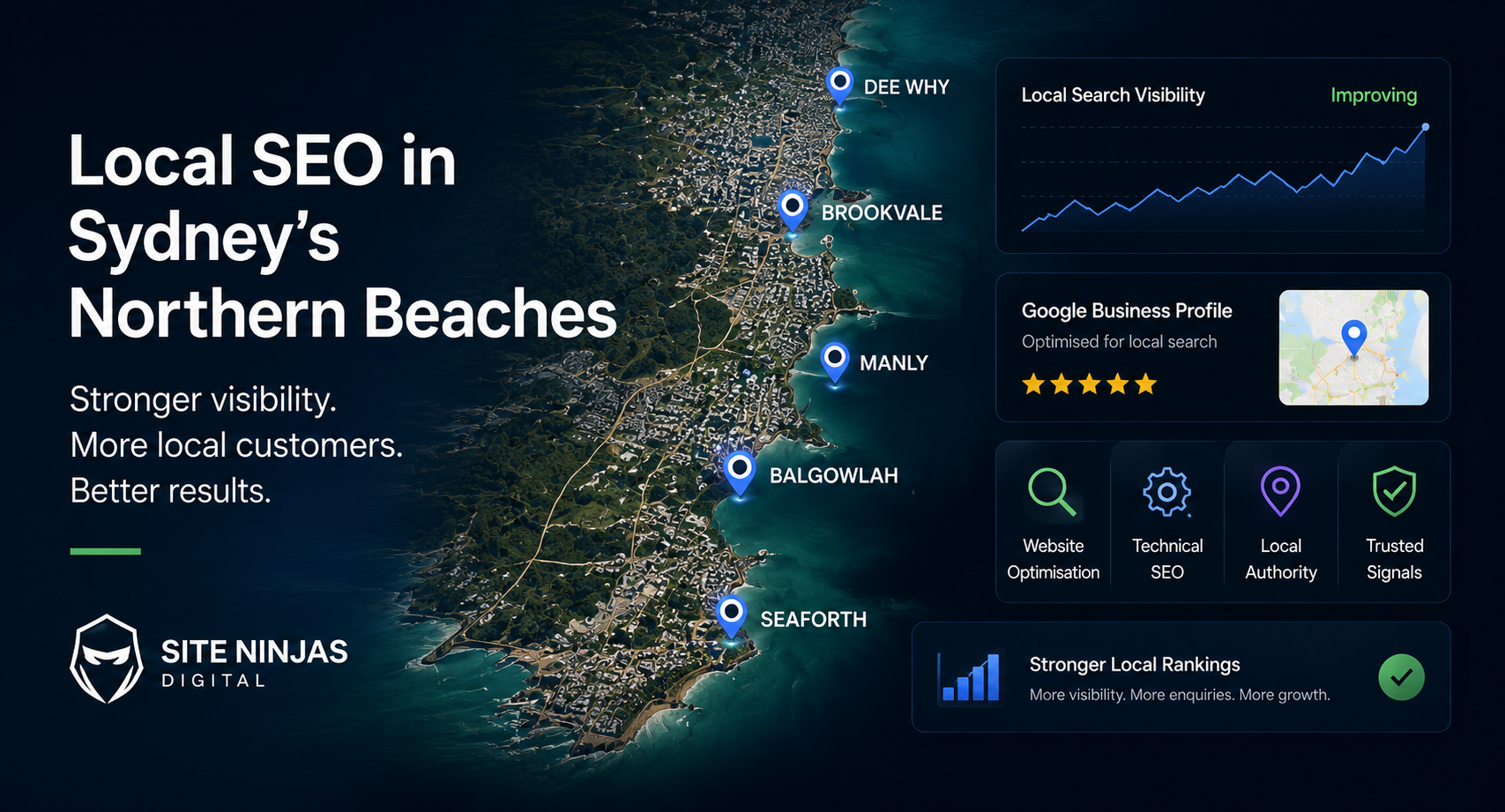
For businesses across Balgowlah, Manly, Dee Why, Seaforth, Brookvale and the wider Northern Beaches, being visible at the right moment can directly affect the number and quality of enquiries received.
That is the purpose of local SEO.
Local search engine optimisation helps businesses improve their visibility when people search for services within a particular suburb, region or nearby area. It connects your website, Google Business Profile, reviews, service information and wider online presence into a clearer local search strategy.
Done properly, local SEO is not about repeating suburb names across every paragraph.
It is about giving customers and search engines consistent evidence that your business provides the service being searched for, operates in the relevant area and deserves to be considered.
What Is Local SEO?
Local SEO is the process of improving a business’s visibility for searches connected to a particular location.
These searches may include a suburb or region, such as:
- web designer Balgowlah
- plumber Manly
- electrician Dee Why
- builder Northern Beaches
- SEO agency Northern Beaches
- local business near me
Other searches may not contain a location at all. Search engines can still use the customer’s location and the nature of the search to present nearby businesses.
Local SEO can therefore influence visibility across:
- standard Google search results
- Google Maps
- local business listings
- Google Business Profile results
- service and suburb searches
- mobile searches made nearby
The aim is not simply to attract more website traffic.
The real objective is to improve visibility among people who are genuinely capable of becoming customers.
Why Local SEO Matters for Northern Beaches Businesses
The Northern Beaches has a strong mix of trades, professional services, consultants, health providers, hospitality businesses, retailers, ecommerce brands and independent operators.
Many of these businesses compete for customers within overlapping service areas.
A business based in Balgowlah may also serve Manly, Seaforth, Fairlight, Brookvale, Dee Why and wider Sydney. A customer searching in any one of those areas may compare several businesses before making contact.
This means your local visibility cannot depend on one homepage paragraph or a single Google listing.
A stronger local presence usually requires several elements working together:
- a properly maintained Google Business Profile
- clear service information
- a well-structured website
- accurate business details
- genuine customer reviews
- locally relevant website content
- strong technical performance
- consistent authority signals
When these elements support one another, the business becomes easier to discover and easier to trust.
How Local Search Visibility Is Built
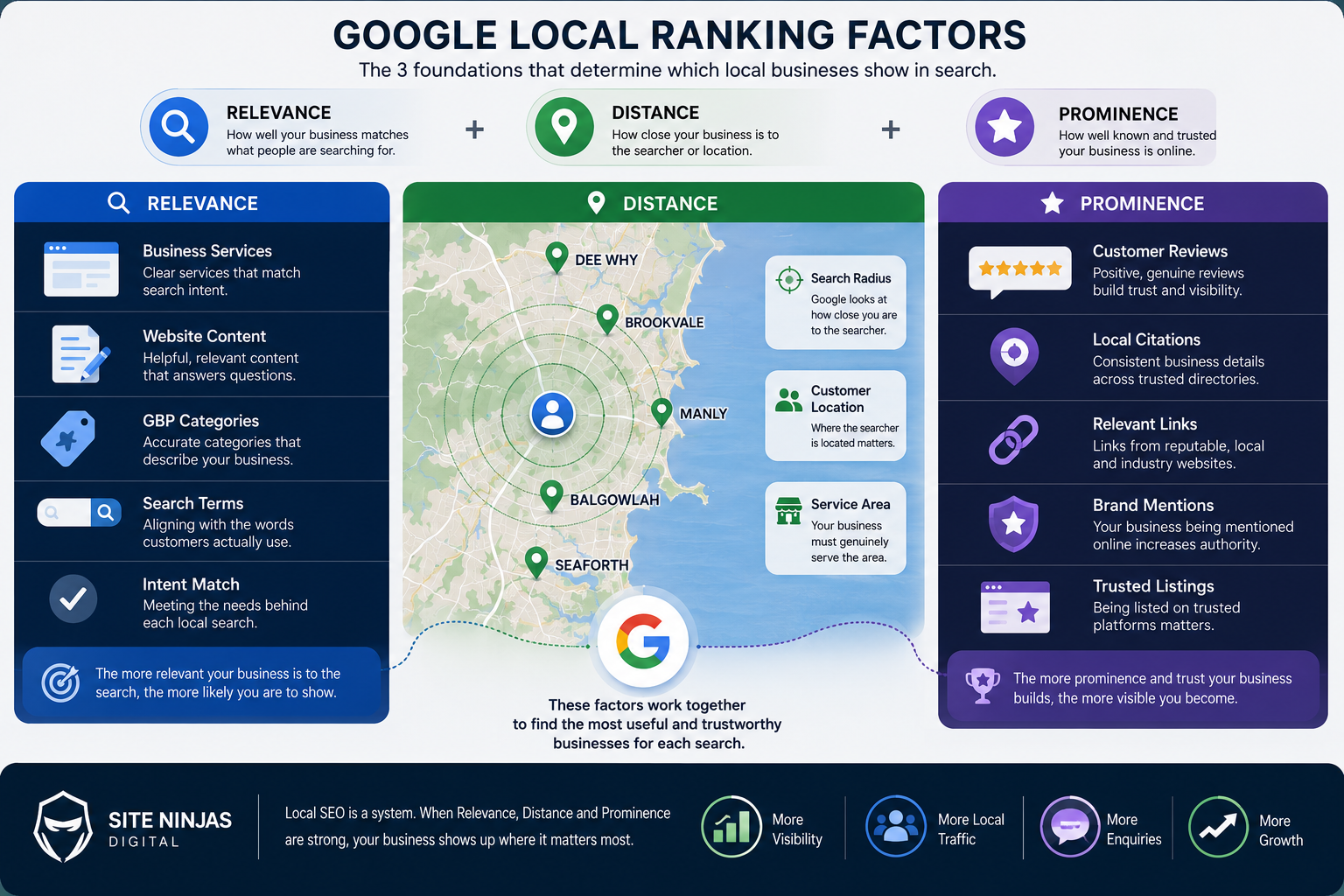
Search engines need to understand three basic things about a local business:
What the business provides
Your services should be explained clearly across your website and Google Business Profile.
Vague claims such as “quality solutions” or “professional service” do not clearly tell customers or search engines what the business actually does.
Each important service should be described using straightforward language that matches how real customers search.
Where the business operates
Your website should clearly communicate your main location and genuine service areas.
For a Northern Beaches business, this may include Balgowlah, Manly, Dee Why, Seaforth, Brookvale, Freshwater, Fairlight, Manly Vale and surrounding Sydney suburbs.
These locations should be included naturally where they help customers understand your coverage. They should not be forced into every heading or paragraph.
Why the business should be trusted
Reviews, project examples, business information, strong service pages, accurate listings and a professional website all contribute to credibility.
Search visibility and customer confidence are closely connected. A business may appear in search, but it still needs to convince the customer to take the next step.
Start With Your Google Business Profile
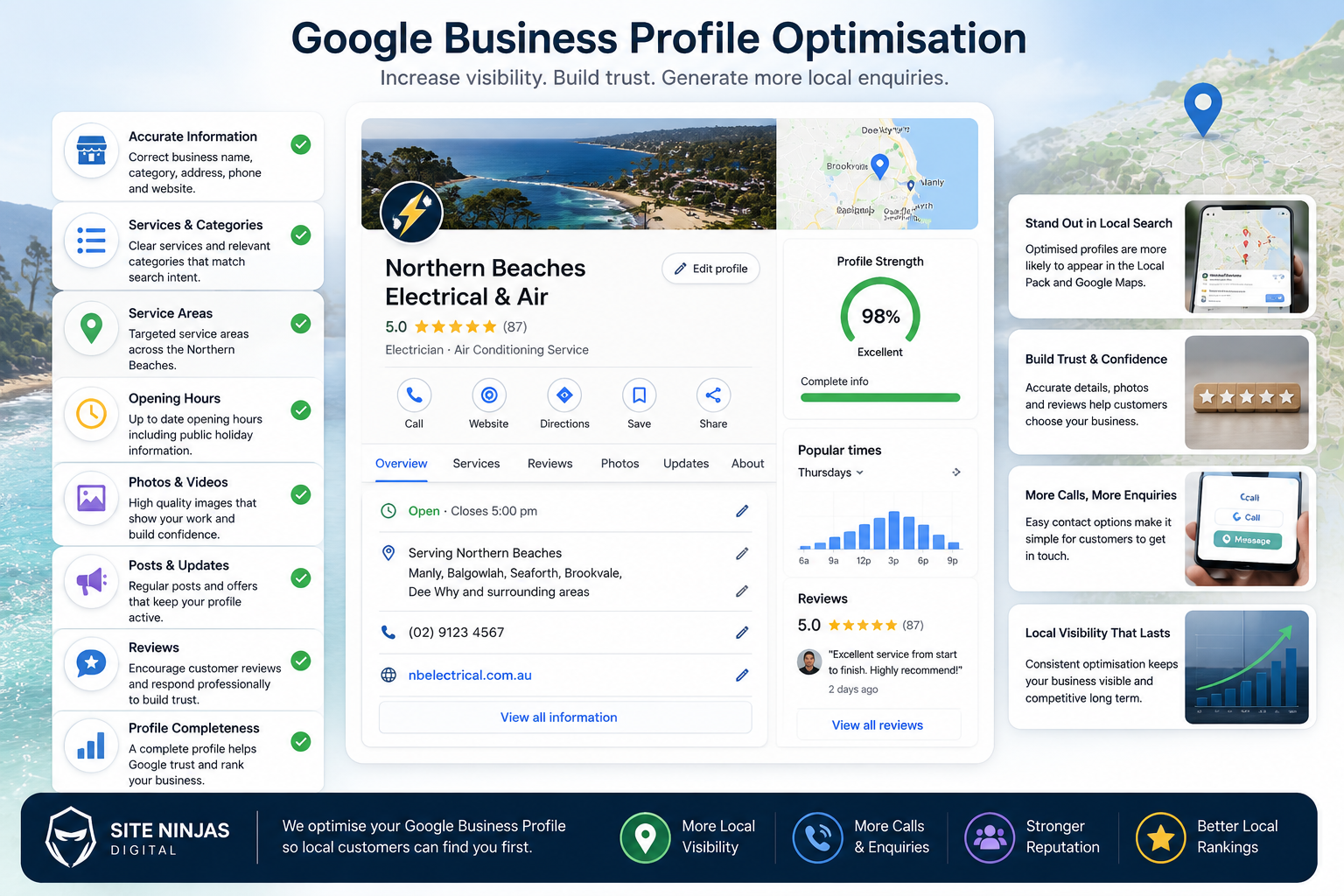
A Google Business Profile is one of the most important parts of a local search presence.
It can display information such as:
- business name
- primary and secondary categories
- phone number
- website
- opening hours
- service areas
- business description
- services
- products
- photographs
- customer reviews
- updates and posts
- booking or enquiry options
An incomplete or neglected profile weakens the business’s local presentation.
The information should remain accurate, current and consistent with the website. Customers should not find one telephone number on Google, another on the website and different opening hours elsewhere.
Choose Accurate Business Categories
The main category should describe the business as precisely as possible.
Additional categories can support other genuine areas of work, but adding unrelated categories does not make a profile stronger.
Accuracy is more valuable than trying to appear under every possible service.
Complete the Service Information
Services should be added individually where possible.
A plumber might separate emergency plumbing, leak repairs, bathroom plumbing and blocked drains. A digital agency might separate web design, web development, SEO, ecommerce and custom CMS development.
This gives prospective customers a clearer understanding of the business and creates a better connection between the profile and the corresponding website pages.
Use Genuine Business Photographs
Photographs help show that the business is active and legitimate.
Depending on the business, useful images may include:
- completed projects
- team members
- vehicles
- premises
- equipment
- before-and-after work
- products
- branded graphics
- website project examples
Images should support the business rather than acting as generic decoration.
Keep the Profile Active
Business updates, new photographs, review responses and accurate service information help prevent the profile from appearing abandoned.
Activity alone does not replace a proper SEO strategy, but a neglected profile is a wasted opportunity.
Build a Website That Supports Local Search
A Google Business Profile should not operate separately from the business website.
The website provides space to explain services properly, build trust, answer customer questions and guide visitors towards an enquiry.
A strong local website should clearly communicate:
- what the business does
- who it helps
- where it operates
- why customers should trust it
- how to make contact
- what the next step involves
When a customer lands on the website, they should not have to search through vague paragraphs to work out whether the business provides the service they need.
Give Important Services Their Own Pages
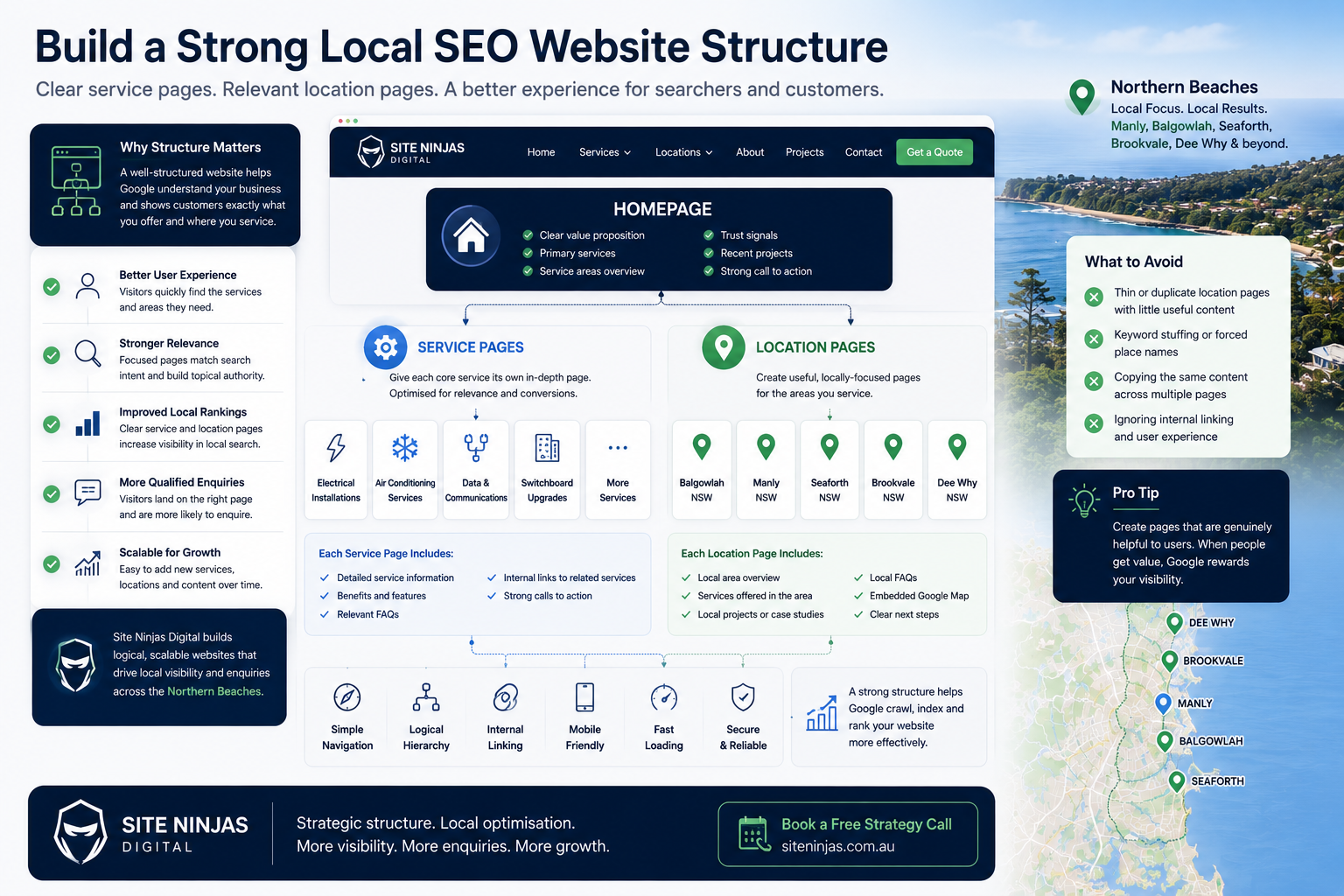
One of the most common local SEO mistakes is placing every service on a single general page.
This makes it harder to explain each service properly and creates weaker search relevance.
A service business may benefit from dedicated pages for its most commercially important services.
For example, a digital agency could use separate pages for:
- web design
- web development
- local SEO
- ecommerce development
- Shopify development
- custom CMS development
- website rebuilding
A trade business could use separate pages for installations, repairs, emergency work, maintenance and specialist services.
Each page should provide useful information rather than existing only to target a keyword.
Use Location Information Naturally
Local relevance should be clear, but the writing still needs to sound professional.
A business based around Balgowlah might explain that it serves customers across Manly, Seaforth, Brookvale, Dee Why and the wider Northern Beaches.
That information could appear within:
- the homepage
- relevant service pages
- the contact page
- service-area information
- project examples
- case studies
- FAQs
- blog articles
Repeating a long list of suburbs throughout every page looks forced and adds little value.
The better approach is to include location information where it helps customers understand the business and its coverage.
Avoid Thin Suburb Pages
Is Your Business Difficult to Find Locally?
Site Ninjas Digital helps businesses across Balgowlah, Manly, Dee Why and the Northern Beaches build stronger websites and local search visibility.
Creating a separate page for every suburb can appear attractive from an SEO perspective, but weak location pages often do more harm than good.
A useful location page should contain genuine information relevant to customers in that area.
It may include:
- services available in the suburb
- examples of nearby work
- common customer requirements
- local project information
- travel or service coverage
- photographs
- testimonials
- relevant FAQs
- clear contact options
Changing only the suburb name while repeating the same paragraph across dozens of pages creates a poor experience and an unconvincing website.
Strong core service pages should generally be established before a business begins expanding into dedicated location pages.
Build a Consistent Review Strategy
Customer reviews can influence whether somebody contacts your business, even when several local companies appear in the same search results.
A strong review profile can demonstrate:
- reliability;
- quality of work;
- communication;
- professionalism;
- local experience;
- and customer satisfaction.
Reviews are particularly valuable when they contain genuine detail about the service completed and the customer’s experience.
For example, a review explaining that a business completed a renovation in Manly or resolved an urgent problem for a customer in Dee Why provides more useful context than a short, generic comment.
Businesses should develop a straightforward and ethical process for requesting reviews from satisfied customers.
This could involve:
- completing the service or project;
- confirming that the customer is satisfied;
- sending a direct Google review link;
- politely requesting honest feedback;
- and responding once the review has been published.
Never purchase reviews, create false customer accounts or pressure customers into using specific keywords.
A steady flow of genuine feedback is far more valuable than an unnatural burst of questionable reviews.
Respond to Customer Reviews
Businesses should respond to both positive and negative reviews professionally.
A useful response can:
- thank the customer;
- acknowledge the specific service;
- demonstrate that the business values feedback;
- clarify a misunderstanding where necessary;
- and show prospective customers that the business communicates properly.
Avoid copying and pasting the same generic response beneath every review.
Responses should sound like they were written by a real business owner or team member.
Keep Your Business Information Consistent
Your core business details should remain accurate across your website, Google Business Profile and other important online listings.
This usually includes:
- business name;
- telephone number;
- website address;
- public address, where applicable;
- opening hours;
- service areas;
- business category;
- and contact information.
Customers can lose confidence when they find conflicting information.
For example, an old telephone number on one directory, outdated opening hours on Google and a different business name on social media create unnecessary confusion.
Important listings to review may include:
- Google Business Profile;
- Apple Business Connect;
- Bing Places;
- Facebook;
- Instagram;
- LinkedIn;
- relevant Australian business directories;
- industry associations;
- supplier directories;
- and trusted local business listings.
Not every directory is worth joining.
The aim is not to submit the business to hundreds of low-quality websites. Focus on accurate listings that are relevant, reputable and useful to potential customers.
Technical SEO Still Matters for Local Businesses
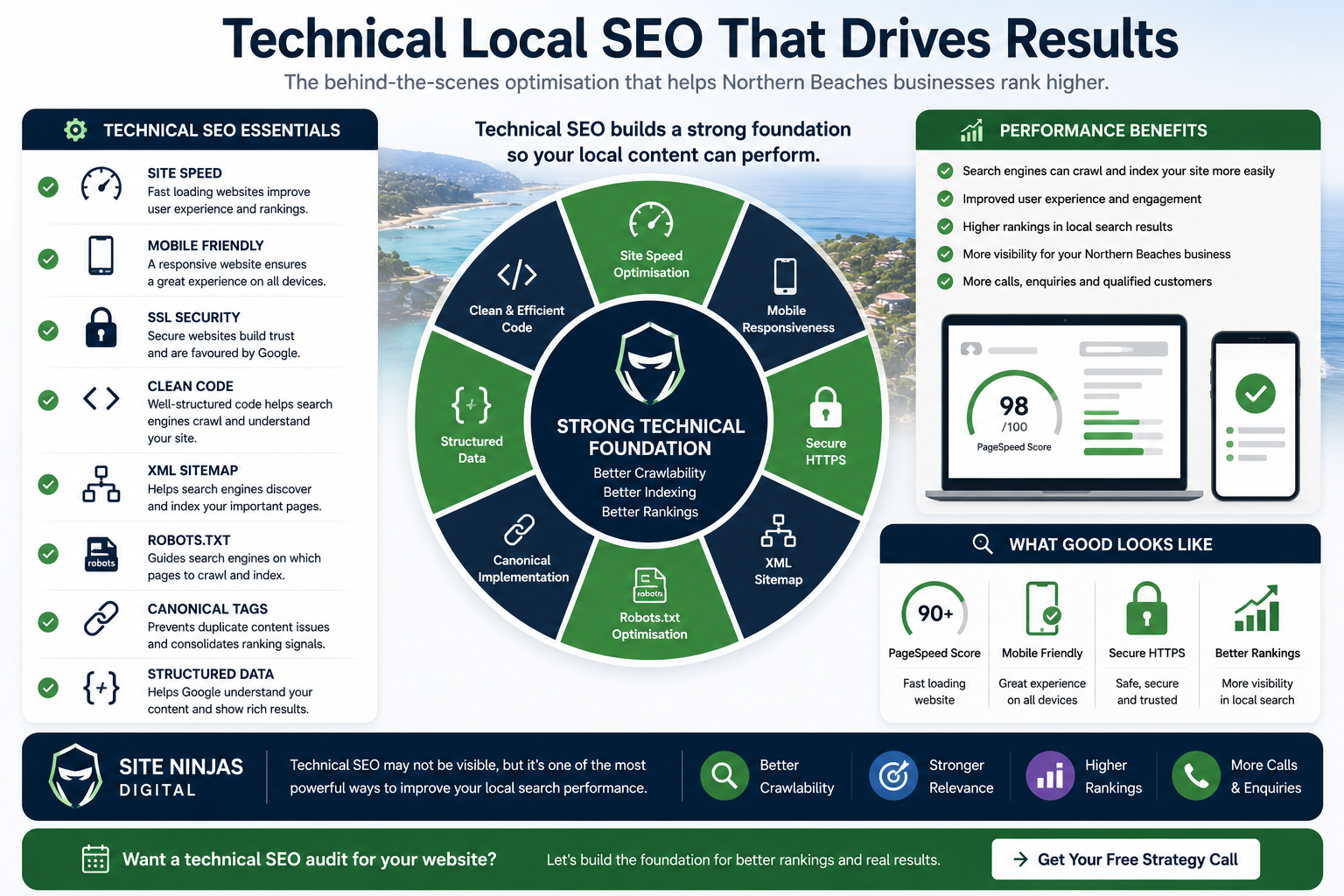
Local SEO is not only about locations, reviews and Google Business Profile updates.
The website must also work properly.
Technical problems can make important pages more difficult for search engines to crawl, understand or index. They can also create a poor experience for customers attempting to use the website.
A technical SEO review may examine:
- mobile usability;
- website loading performance;
- crawlability;
- indexation;
- broken links;
- redirect problems;
- duplicate pages;
- page titles and metadata;
- XML sitemap configuration;
- canonical URLs;
- structured data;
- image optimisation;
- website security;
- and overall page architecture.
Technical SEO does not replace useful content, but it creates a stronger foundation for that content to perform.
Mobile Performance Is Essential
Many local searches happen on mobile devices.
A customer may be comparing providers while travelling, standing near a job site, dealing with an urgent problem or searching outside normal business hours.
The mobile website should therefore make it easy to:
- understand the service;
- confirm the service area;
- view examples of work;
- read customer reviews;
- call the business;
- send a WhatsApp message;
- complete an enquiry form;
- and find important contact information.
A website that is difficult to navigate on a phone can lose the customer even after earning the search click.
Make Contact Options Clear
Local visitors should not have to search through several pages to find a phone number or enquiry form.
Useful contact features may include:
- clickable telephone numbers;
- visible email links;
- WhatsApp contact;
- short enquiry forms;
- clear opening hours;
- directions where appropriate;
- and prominent calls to action.
Local SEO should not stop when the visitor reaches the website.
The website must then convert that visibility into a practical opportunity for contact.
Publish Content Based on Genuine Experience
A local business website should demonstrate genuine knowledge of its work, customers and service area.
Generic articles written only to fill space rarely build much trust.
Stronger content may include:
- detailed project case studies;
- before-and-after examples;
- answers to common customer questions;
- explanations of common problems;
- service comparisons;
- maintenance advice;
- local planning or compliance considerations;
- pricing factors;
- project processes;
- and lessons learned through real work.
For example, a Northern Beaches builder could publish information about renovation planning, difficult site access, coastal conditions or project preparation.
A local digital agency could explain website rebuilding, Google Business Profile optimisation, service-page structure or common technical problems found on older websites.
The content should reflect what the business genuinely knows.
Create Content Around Customer Questions
Useful blog topics often begin with questions customers already ask.
Examples include:
- How much does a business website cost?
- Does my website need a complete rebuild?
- How long does local SEO take?
- Should every service have its own page?
- How do Google reviews affect a local business?
- What should I include on a Northern Beaches service page?
- Why has my website traffic dropped?
- Should I use WordPress or a custom CMS?
- How can I improve my Google Business Profile?
Each article should answer the question properly and link naturally to the relevant service.
The objective is not to produce a high volume of shallow posts. It is to build a useful collection of content that supports the business’s services and demonstrates real expertise.
Use Internal Links to Connect Related Pages
Internal links connect one page of your website to another.
They help visitors discover related information and help search engines understand how the website is organised.
For example, this local SEO guide can link to:
- the Site Ninjas Digital SEO service page;
- the Northern Beaches web design guide;
- the web development service;
- the NinjaCMS article;
- and the contact page.
The SEO service page should also link back to this guide.
Use meaningful link wording rather than vague phrases such as “click here”.
Better examples include:
- local SEO services for Northern Beaches businesses;
- SEO-focused web design;
- custom web development;
- Google Business Profile optimisation;
- and custom CMS development.
The words used in the link should make it clear what the destination page contains.
Avoid Isolated Pages
Every important service page, article and case study should be linked from somewhere else on the website.
A useful page that is never linked internally can become difficult for customers and search engines to discover.
The website should operate as a connected structure rather than a collection of isolated pages.
Measure Enquiries, Not Only Rankings
Keyword rankings provide useful information, but they are not the final measure of success.
A website can rank for many searches and still generate little commercial value if those searches are irrelevant.
Local SEO reporting should consider the quality of the visibility being created.
Useful measurements may include:
- visibility for relevant service searches;
- Google Business Profile interactions;
- website visits from local searches;
- telephone calls;
- contact-form submissions;
- WhatsApp enquiries;
- booking requests;
- direction requests;
- page engagement;
- and completed sales where reliable tracking is available.
Google Search Console can help identify which searches and pages are generating impressions and clicks.
Website analytics can help show what visitors do after arriving.
Conversion tracking can then connect those visits with phone calls, forms, bookings or other meaningful actions.
The key question is not simply:
Did website traffic increase?
It is:
Did the business create more relevant opportunities from search?
How Long Does Local SEO Take?
Local SEO is a long-term process rather than an instant traffic switch.
Some improvements may appear relatively quickly after:
- correcting inaccurate business information;
- fixing broken pages;
- improving an incomplete Google Business Profile;
- resolving indexation issues;
- or optimising a poorly structured service page.
Stronger progress usually develops over time.
The timeframe can depend on:
- current website quality;
- existing search visibility;
- local competition;
- the services being targeted;
- the suburbs being targeted;
- review strength;
- website authority;
- technical problems;
- content quality;
- and how consistently the strategy is implemented.
A newer business targeting a highly competitive service across Sydney may require more time than an established business targeting a specialist service within a smaller local area.
Businesses should be cautious of anyone guaranteeing immediate first-place rankings.
No agency controls Google’s results, competitors or future search-system changes.
A credible SEO strategy should focus on structured improvement, transparent reporting and commercially relevant progress.
Common Local SEO Mistakes
Trying to Target Every Service and Suburb on One Page
A page overloaded with dozens of keyword combinations becomes difficult to read and unclear in purpose.
Important services should normally have their own properly developed pages.
Creating Duplicate Suburb Pages
Replacing one suburb name while keeping the rest of the page identical creates weak, repetitive content.
Location pages should offer genuine local relevance and useful information.
Ignoring the Google Business Profile
A strong website and neglected Google Business Profile do not form a complete local strategy.
Both should contain accurate, consistent and useful information.
Using the Wrong Business Categories
The primary Google Business Profile category should represent the main business activity as closely as possible.
Adding unrelated categories can confuse the business’s positioning.
Publishing Thin Content
A short article that repeats a keyword without properly answering the reader’s question provides little value.
Content should demonstrate knowledge and help the customer make a better decision.
Buying Low-Quality Backlinks
Cheap backlink packages may generate impressive-looking numbers without creating meaningful authority.
Relevant, trustworthy mentions are more valuable than large quantities of poor-quality links.
Neglecting Mobile Visitors
A slow or awkward mobile website can lose customers before they read the service information.
Inconsistent Contact Information
Different phone numbers, website addresses or opening hours across platforms can confuse customers and make listings harder to maintain.
Measuring Traffic Without Tracking Enquiries
Traffic growth may look encouraging, but the business also needs to understand whether search visitors are making contact.
Stopping After the Initial Setup
Local competitors continue collecting reviews, improving their websites, publishing content and updating their profiles.
Local SEO requires continued maintenance rather than a one-off burst of activity.
Local SEO Across Sydney’s Northern Beaches
Site Ninjas Digital supports businesses across Balgowlah, Manly, Seaforth, Brookvale, Dee Why, Freshwater and the wider Northern Beaches.
Our local SEO work can include:
- Google Business Profile optimisation;
- technical SEO reviews;
- keyword and competitor research;
- service-page planning;
- location-focused content;
- website structure improvements;
- metadata and heading optimisation;
- internal linking;
- business listing consistency;
- local citation development;
- review strategy;
- authority building;
- performance tracking;
- and ongoing search improvements.
Every strategy should be shaped around the actual business.
A trade company serving nearby residential customers requires a different approach from a consultant working across Sydney.
A physical shop has different local requirements from a mobile service business.
An established company with years of customer reviews begins from a different position than a newly launched business.
There is no useful one-size-fits-all local SEO strategy.
The right approach depends on the business’s services, target locations, competition, current website and commercial priorities.
Build a Stronger Local Search Presence
Being visible at the right moment can make the difference between receiving an enquiry and losing it to a nearby competitor.
A strong local SEO strategy brings your Google Business Profile, website structure, service content, reviews, business information and technical foundation together into one organised system.
For businesses across Balgowlah, Manly, Seaforth, Brookvale, Dee Why and the wider Northern Beaches, Site Ninjas Digital provides practical local SEO support focused on relevant visibility and genuine commercial opportunities.
We do not chase meaningless traffic or temporary ranking spikes.
We build structured search foundations designed to improve discoverability, strengthen trust and create more opportunities for relevant enquiries over time.
Ready to Improve Your Local Google Visibility?
Speak with Site Ninjas Digital about a local SEO strategy built around your business, services and target locations.
Northern Beaches Areas We Support
Site Ninjas Digital supports businesses across Balgowlah, Manly, Dee Why, Seaforth, Brookvale, Freshwater, Fairlight, Manly Vale and wider Sydney.
Ready to Improve Your Local Google Visibility?
Site Ninjas Digital builds structured websites, custom NinjaCMS platforms, and data-driven local SEO campaigns for service businesses across Sydney's Northern Beaches.
Frequently Asked Questions
Does Local SEO Only Improve Google Maps Rankings?
No. Local SEO can support visibility across Google Maps, Google Business Profile results, and standard organic search results.
It involves several connected elements, including your website, Google Business Profile, service content, technical SEO, reviews, business listings, and wider authority.
Do I Need a Separate Website Page for Every Suburb?
Not automatically. Strong service pages should usually be developed before creating large numbers of location pages.
A dedicated suburb page may be worthwhile when:
- the area is commercially important;
- there is genuine search demand;
- the business regularly serves that location;
- local examples or projects are available;
- and the page can provide unique, useful information.
Avoid creating dozens of pages that contain essentially the same text.
Can a Service-Area Business Rank Without Displaying a Public Address?
Yes. A legitimate service-area business may operate a Google Business Profile without publicly displaying a residential address, provided the profile is configured correctly and follows Google’s requirements.
The website should still explain the genuine areas the business serves.
How Many Google Reviews Does My Business Need?
There is no universal number that applies to every business. The appropriate target depends on your industry, location, competitors, and current reputation.
A business competing against companies with hundreds of established reviews may face a different challenge from a specialist provider in a smaller market.
Focus on collecting a consistent flow of honest reviews from genuine customers rather than chasing an arbitrary total.
Should I Add Suburb Names to Every Website Page?
No. Location information should be used where it helps visitors understand where the business operates.
Repeatedly forcing the same suburb list into every section can make the website difficult to read and may weaken the overall quality of the content.
Use local references naturally across important service pages, contact information, case studies, FAQs, and relevant articles.
How Long Does Local SEO Take to Work?
Some technical fixes and profile improvements may create early movement, but stronger progress commonly develops over several months.
The timeframe depends on the website, competition, target locations, services, content, reviews, and existing authority.
Local SEO should be treated as an ongoing investment rather than a one-time setup.
Can Site Ninjas Digital Guarantee First Position on Google?
No credible SEO provider can guarantee a particular organic or local ranking position.
Google’s results can change, competitors continue improving their own presence, and no external agency controls the search algorithm.
Site Ninjas Digital provides structured research, technical improvements, content optimisation, local search support, and transparent tracking focused on sustainable progress.