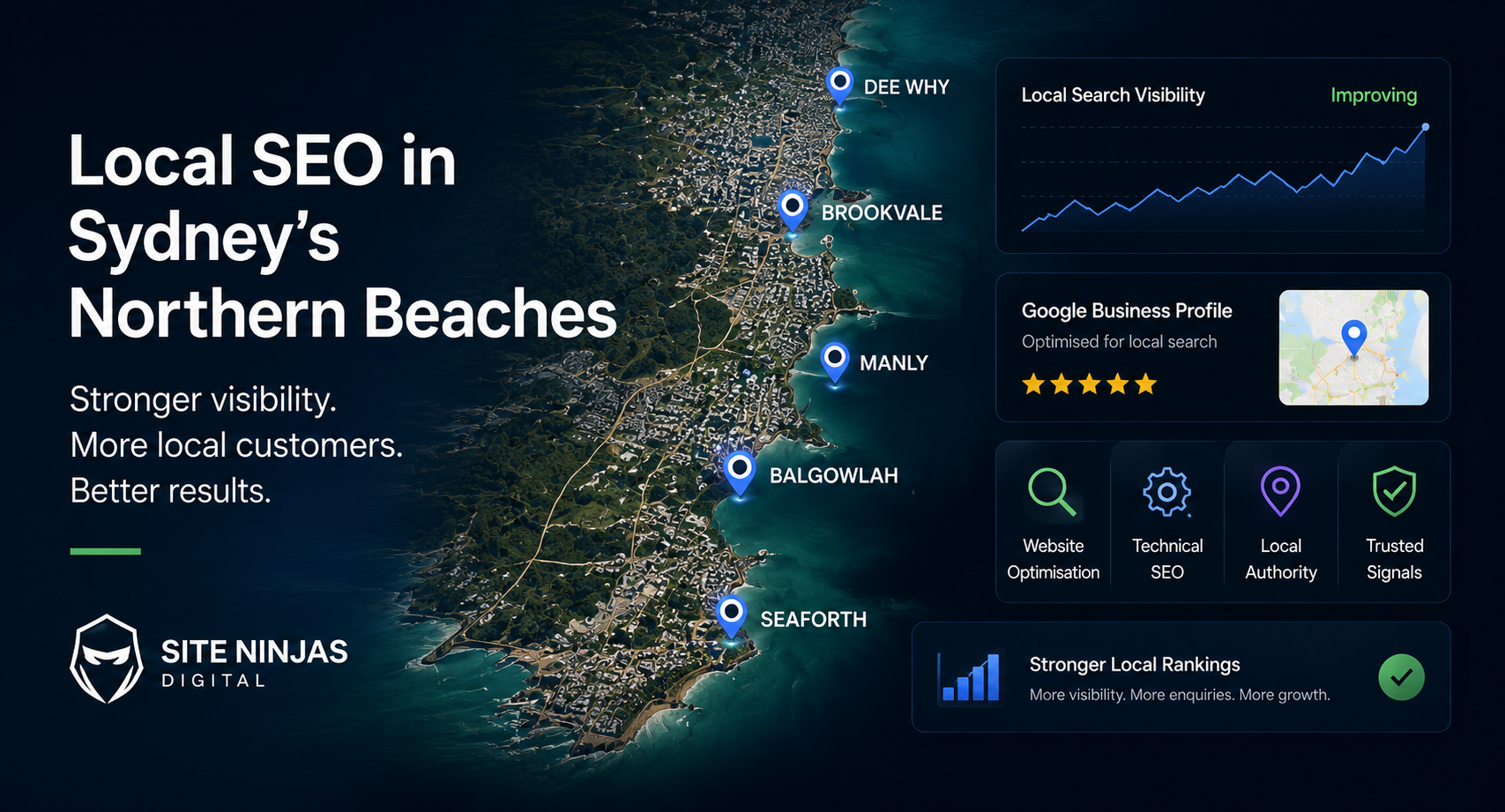
Displaying a Private Address Customers Cannot Visit
This may create privacy concerns, customer confusion and an inaccurate representation of how the business operates.
Published on July 2026 • 8 min read • By Site Ninjas Team
Mobile trades and service providers can hide their home address on Google while building strong local search relevance across target suburbs.
Many trades, mobile services and home-based businesses face the same local SEO problem.
They travel to their customers rather than serving people from a public shopfront, office or showroom. They may cover several suburbs, but they do not want their residential address displayed online.
That creates several understandable questions:
The encouraging answer is that a legitimate service-area business can build strong local visibility without publicly displaying its address.
However, hiding an address does not remove the need for a real business location, accurate profile information, useful website content and a properly structured local SEO strategy.
A service-area business cannot simply add every suburb in Sydney to its profile and expect to appear everywhere.
The business still needs to demonstrate what it provides, where it genuinely works and why customers should trust it.
This guide explains how service-area businesses can build local search visibility across Manly, Balgowlah, Seaforth, Brookvale, Dee Why and the wider Northern Beaches without creating misleading locations or repetitive suburb pages.
Yes.
A legitimate service-area business can operate a Google Business Profile with its public address hidden when customers are not served at that address.
The profile can instead display the areas where the business provides its services.
However, hiding the address does not guarantee rankings across every selected suburb. Visibility still depends on factors such as location, relevance, competition, website quality, reviews and the wider authority of the business.
Potentially, yes.
A business based around Balgowlah might gain visibility for suitable searches across Manly, Seaforth, Fairlight, Brookvale and other nearby Northern Beaches locations.
The strength of that visibility may vary from suburb to suburb.
Selecting an area inside the profile does not create a separate business location there. The website, profile, reputation and real operating history must collectively support the areas being targeted.
Usually not.
A genuine service-area business normally uses one profile for its central business location and overall service area.
Additional profiles are appropriate only when the business operates legitimate separate locations with their own staff and service coverage—not simply because the company wants to rank in another suburb.
A service-area business travels to customers or delivers services directly to their locations instead of serving them at the business address.
Common examples include:
The customer does not normally visit the business’s home, warehouse or administrative office.
Instead, the business travels to homes, workplaces, construction sites or other customer locations.
This differs from a traditional storefront business, where customers are invited to visit a shop, office, clinic, restaurant or showroom during stated opening hours.
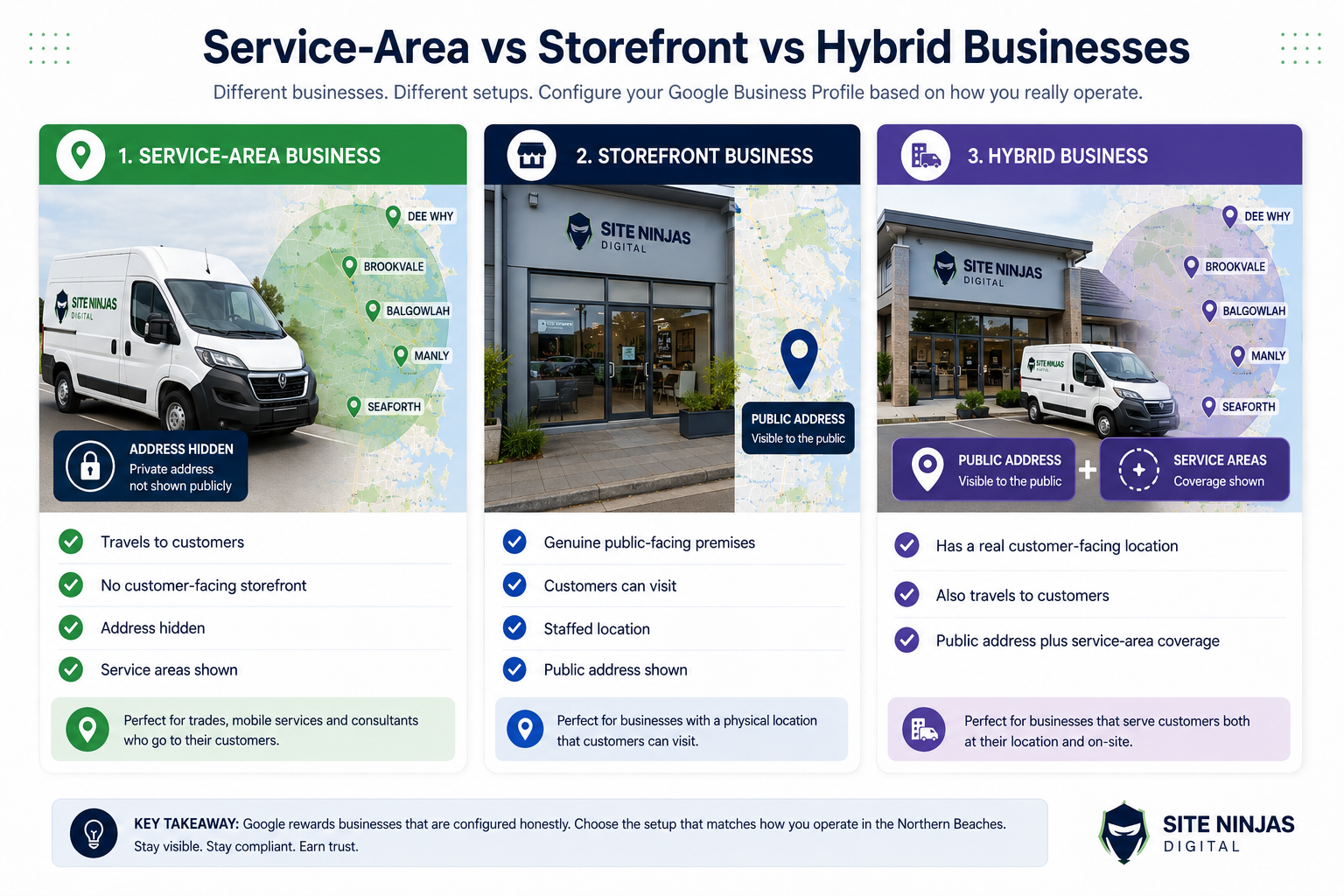
Understanding the correct business type is important before changing a Google Business Profile.
A service-area business visits customers but does not serve them from the address used to operate or verify the business.
The public address should normally be hidden.
The profile displays the areas where the business provides its services instead.
Examples include a plumber working from home, a mobile detailing business or an electrician storing equipment at a private workshop where customers do not visit.
A storefront business serves customers from a genuine public location.
The location should normally:
Examples include a retail shop, restaurant, clinic or publicly accessible office.
A hybrid business serves customers from a staffed public location and also travels or delivers to customers.
For example, an air-conditioning company may operate a genuine showroom while also visiting properties for installation and maintenance work.
A hybrid business may be able to display both its public address and its genuine service areas.
A business should normally hide its address when customers are not invited or permitted to visit that location.
This is particularly important when the address is:
Displaying a private address may create privacy and security concerns.
It may also mislead customers into believing they can visit the location during business hours.
Hiding the address does not mean pretending the business has no physical base. Google may still require an actual location for verification and profile administration.
The difference is that the address is not displayed publicly when the business serves customers elsewhere.
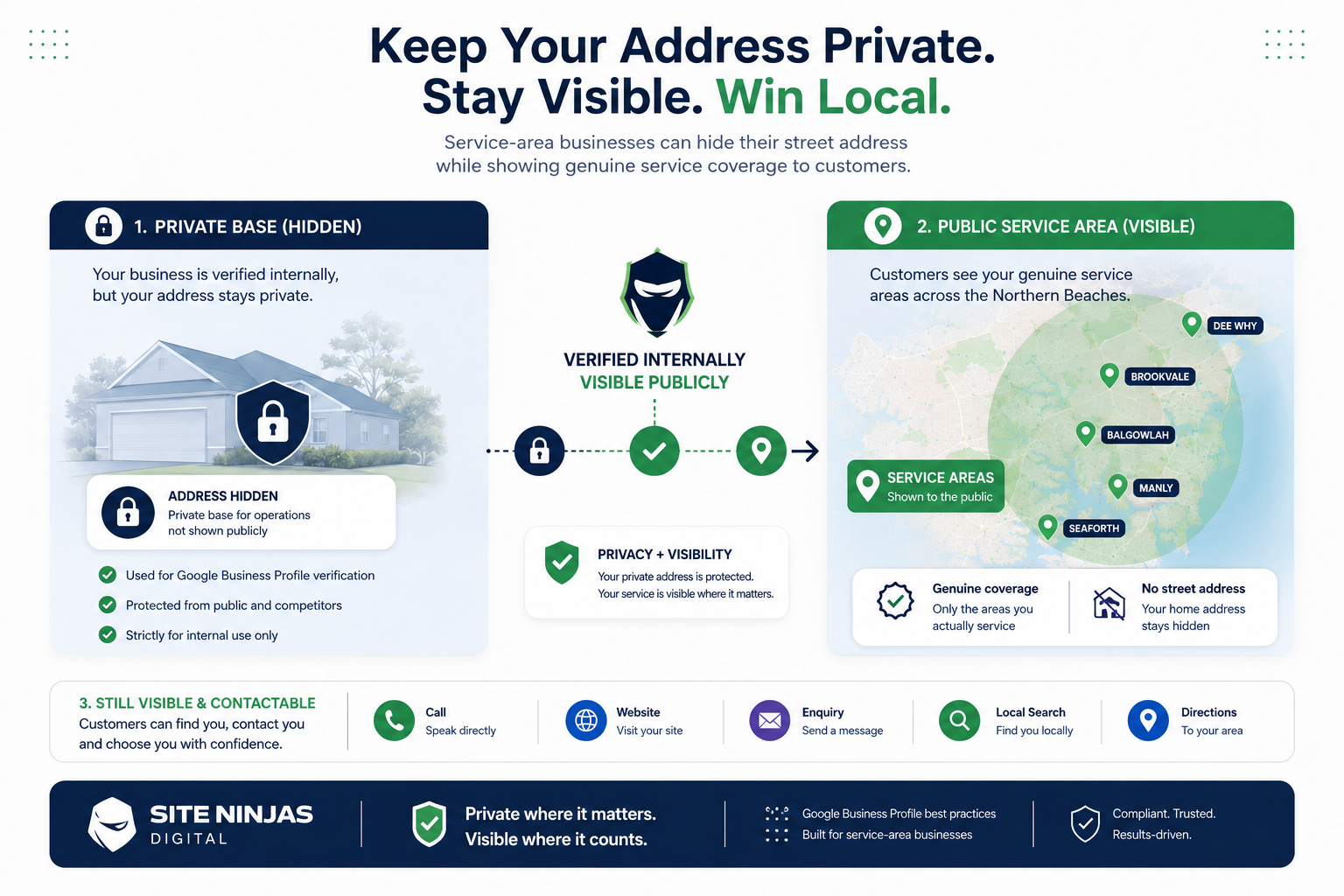
When a service-area business hides its public address, the profile can instead show its service area.
The profile may still display useful customer information such as:
Customers can still discover the business, view its profile, visit its website and make contact.
However, the business will not display itself as a public storefront at the hidden location.
This is the correct setup for many trades and mobile operators.
Hiding an address does not automatically prevent a legitimate service-area business from appearing in local results.
The profile type should reflect how the business actually operates.
Showing an address that customers cannot visit is not a sensible shortcut. It can create customer confusion and may conflict with Google’s business-profile requirements.
Local visibility should instead be built through:
The question should not be:
How can I display an address simply to appear closer to customers?
It should be:
How can I build genuine local relevance across the areas my business actually serves?
That is a safer and more sustainable foundation.
Service areas tell customers where the business provides its products or services.
They help communicate the geographical coverage of a mobile or service-area business.
A Northern Beaches company might select genuine areas such as:
The selected areas should be accurate and commercially realistic.
Adding a suburb should mean the business genuinely accepts and completes work there.
Service areas should not be treated as a list of keywords.
They are customer-facing business information.
Selecting a suburb inside a Google Business Profile does not create:
For example, adding Dee Why as a service area does not automatically make a Balgowlah business equally visible to every customer searching in Dee Why.
The profile setting is only one part of the wider local search picture.
Google still needs to consider how closely the business matches the search, how far it is from the searcher and how established it appears.
That is why the website, reviews, project history and broader local authority remain important.
A business should focus on areas it genuinely serves rather than trying to select the largest possible territory.
A useful service-area list should reflect:
A Northern Beaches trade business may reasonably focus on nearby suburbs instead of claiming all of Sydney, Newcastle, Wollongong and the Central Coast.
Overly broad coverage can weaken the clarity of the business’s positioning.
It can also create customer enquiries from areas the business is unable or unwilling to serve properly.
A smaller, more accurate service area is often commercially stronger than a huge, unrealistic one.
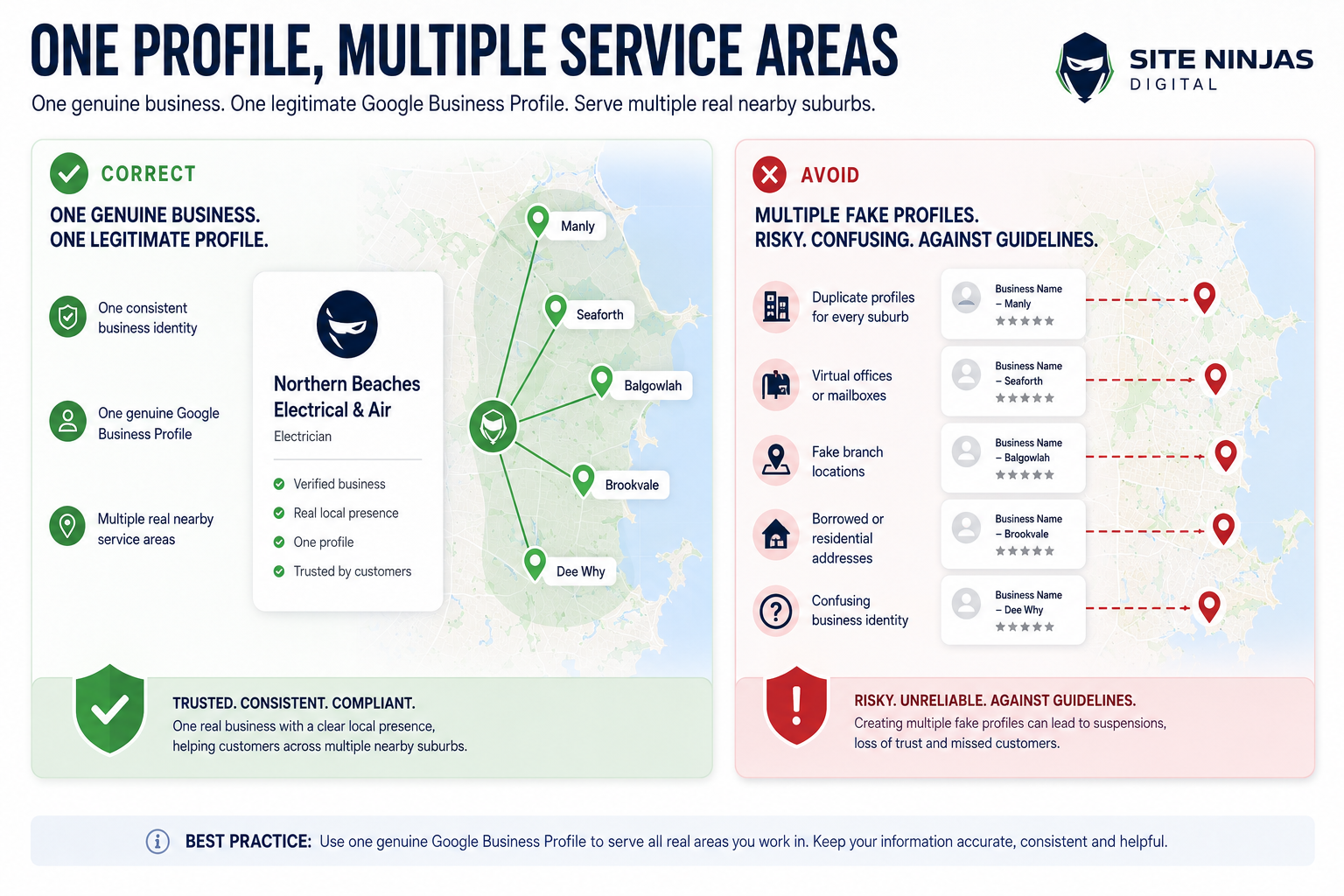
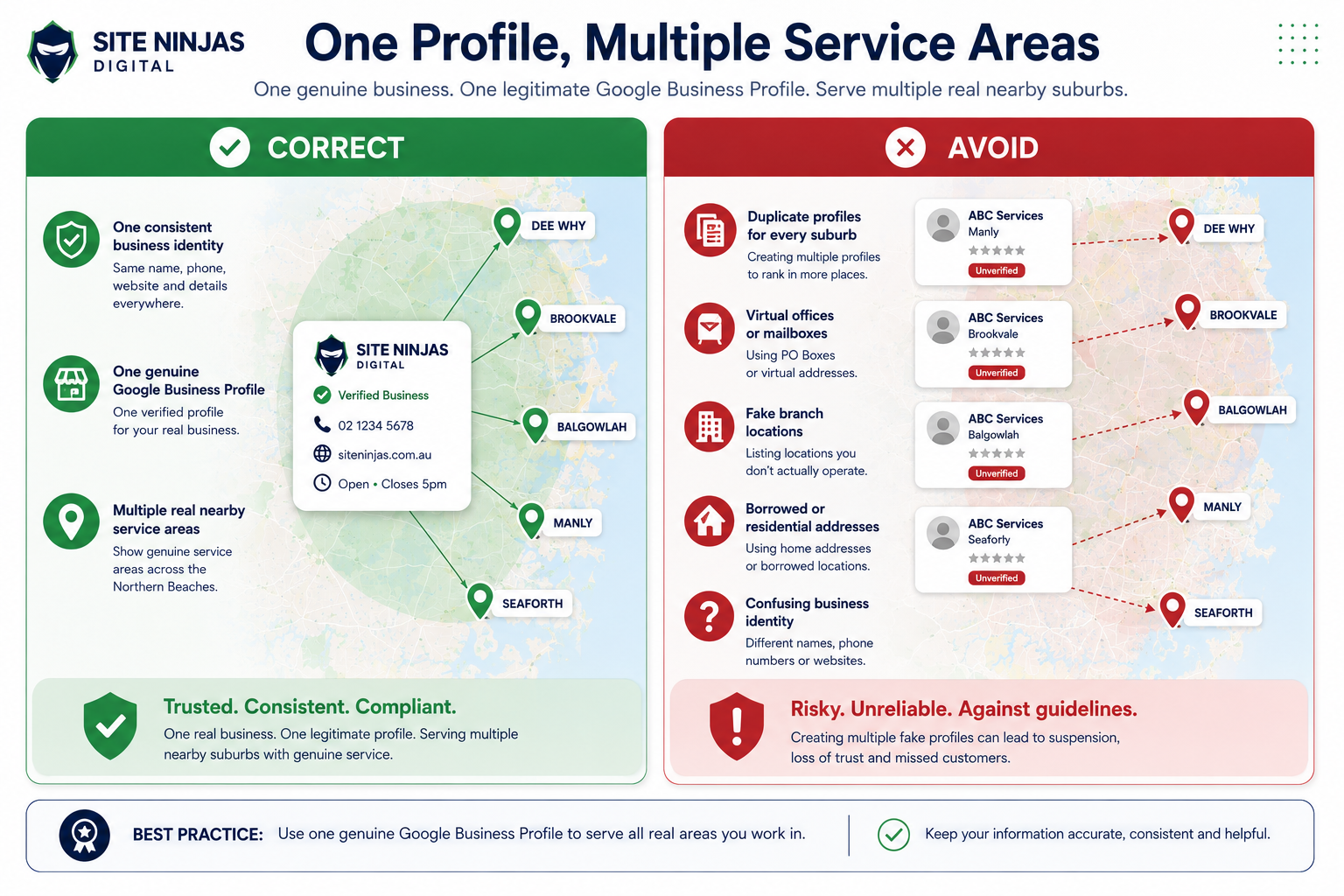
A service-area business should not create separate profiles merely to target additional suburbs.
For example, a business should not create:
when all four profiles represent the same business operating from the same underlying location.
That creates duplicate or misleading locations.
Separate profiles may be appropriate when the business genuinely has multiple operational locations.
Each location should have:
A rented mailbox, temporary room, virtual office or borrowed address does not automatically create a legitimate separate business location.
The location must represent a real part of the business.
A virtual office should not be treated as an easy way to manufacture a presence in another local market.
A business location needs to represent genuine, ongoing operations.
Simply paying to receive mail at an address does not mean customers are served there or that the business genuinely operates from that location.
Similarly, occasionally booking a meeting room does not necessarily create a permanent customer-facing branch.
Businesses considering multiple profiles should ask:
If the honest answer is no, the business should not present it as another physical branch.
A profile may list several suburbs, but local visibility can still remain strongest near the genuine business location.
That is because each suburb may have:
A business cannot control physical distance, but it can improve how clearly and credibly it presents its services.
To compete across several areas, it may need to strengthen:
The goal is not to trick Google into believing the business is located in every suburb.
The goal is to establish that the business genuinely serves those areas and has enough relevance and credibility to be considered.
Site Ninjas Digital helps trades, mobile operators and service businesses improve their Google Business Profile, website structure and local visibility across Balgowlah, Manly, Seaforth, Dee Why and the wider Northern Beaches.
To improve visibility across multiple suburbs, the business should strengthen the connection between:
A business based in Balgowlah may regularly serve customers in Manly, Seaforth, Brookvale, Dee Why and Freshwater.
That does not mean every suburb will produce identical search visibility.
The business may be more visible close to its base, in areas where it has completed more work or in locations where fewer established competitors are present.
Local SEO should therefore be approached suburb by suburb rather than assuming one setting will produce equal rankings across an entire region.
Before creating location pages, the website should properly explain the services the business provides.
A plumber attempting to rank across the Northern Beaches will usually benefit more from strong pages covering services such as:
than from publishing twenty shallow suburb pages that all say essentially the same thing.
Each important service page should answer questions such as:
Strong service pages create the foundation.
Location pages, case studies and supporting articles should then strengthen that foundation rather than replace it.
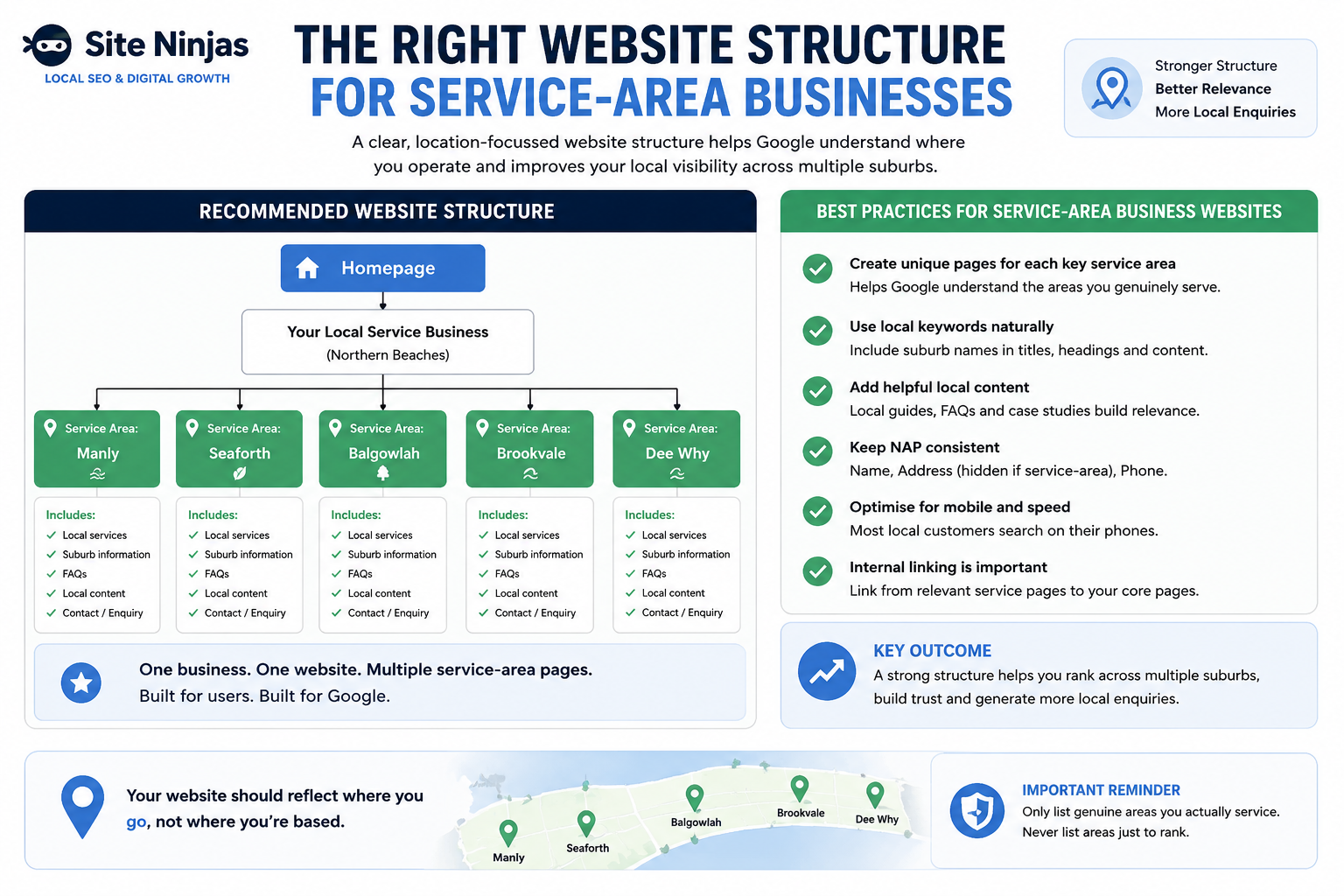
A service-area website should be organised so customers and search engines can understand the relationship between services, locations and supporting information.
A practical structure may include:
An overview of the business, its main services, central location and wider service area.
Dedicated pages for each commercially important service.
Useful pages for high-priority suburbs or service areas where the business has genuine work, demand and local relevance.
Real examples showing what was completed, where it took place and how the customer was helped.
Guides answering common questions, explaining service issues and supporting important service pages.
Clear contact options and an honest explanation of where the business operates.
These pages should connect through sensible internal links.
A project completed in Manly might link to the relevant service page and the Manly location page. The service page might link to related projects, FAQs and booking information.
This creates a useful network of information rather than a collection of disconnected pages.
No.
A separate page is only worthwhile when the business can create something genuinely useful for customers in that location.
A location page may be justified when:
A location page should not exist merely because the suburb was added to a list inside Google Business Profile.
The website does not need a separate page for every selected service area.
It needs useful pages for the locations that matter most.
A strong location page should help somebody in that area understand the service and decide whether the business is suitable.
Useful content may include:
For example, a useful electrician page for Manly might discuss:
The page should offer more than a paragraph saying the electrician is “proud to serve Manly”.
A doorway-style approach creates multiple pages primarily to capture similar searches and send every visitor towards the same general destination.
A website might publish separate pages for:
while changing little more than the suburb name.
These pages usually provide no meaningful local information and offer nearly identical user experiences.
That approach makes the website repetitive and less useful.
Instead, businesses should:
Five useful local pages are better than fifty weak ones.
One of the strongest ways to demonstrate local relevance is through real work.
A service-area business should record where projects take place and, where permission allows, use that information across the website.
Local proof may include:
A case study might explain:
For example:
A blocked-drain investigation completed for a residential property in Seaforth identified root intrusion within an older section of pipework. The affected area was cleared, inspected and documented before repair options were discussed with the owner.
That is more useful and believable than repeatedly claiming to be the “best plumber in Seaforth”.
Local proof should never expose private customer information without permission.
Avoid publishing:
Suburb-level project information is usually enough to establish local relevance.
Reviews can help prospective customers understand whether a service-area business is reliable, professional and experienced.
A practical review process may involve:
Businesses should not tell customers exactly what to write.
However, customers often naturally mention:
Those details can provide useful context for future customers.
The aim is not to manipulate customers into repeating location keywords.
The objective is to build a genuine reputation through consistent service.
A steady flow of authentic reviews across the business’s real service area is more credible than an unnatural collection of heavily scripted reviews.
A service-area business should maintain consistent core information across important online platforms.
This includes:
Relevant listings may include:
The business should not create false addresses inside directory listings simply to appear in more suburbs.
Listings should accurately reflect whether the business is:
Accuracy is more important than the number of directory entries.
A service-area business should not rely on its homepage to explain every service and location.
The website linked from the Google Business Profile should make the business’s offering immediately clear.
The homepage should usually explain:
Individual services should then link to dedicated pages.
Google Business Profile service entries, posts and other features can also direct customers towards relevant website content where the platform permits.
A customer interested in switchboard upgrades should reach useful switchboard information—not a vague homepage requiring several more clicks.
Internal links help customers move between related services, locations, case studies and articles.
For example:
The linked wording should describe the destination.
Use:
Avoid relying entirely on vague wording such as:
A connected site structure makes the website more useful and helps important pages avoid becoming isolated.
Service-area businesses can strengthen their website by answering questions that real customers ask.
Useful article topics may include:
The strongest content usually comes from genuine customer conversations and real work.
It should solve a problem, clarify uncertainty or help somebody make a better decision.
It should not exist purely to repeat a target keyword.
Service-area customers often search from mobile devices.
They may need urgent help, compare several providers or contact a business while away from a computer.
The website should make it easy to:
Important contact actions should be visible without forcing the customer to search through the website.
The enquiry form should also ask for enough information to confirm whether the customer falls inside the genuine service area.
Useful fields may include:
This can reduce unsuitable enquiries while making legitimate enquiries easier to assess.
A service-area business should measure more than total website traffic.
Useful performance information may include:
This can help identify:
A business may discover that three nearby suburbs produce most of its profitable work while distant locations create time-consuming, low-value enquiries.
Local SEO should support business operations—not force the company to serve an impractical area.
This may create privacy concerns, customer confusion and an inaccurate representation of how the business operates.
A huge service area does not automatically create wider visibility.
It can also attract unsuitable enquiries from areas the business cannot serve efficiently.
Separate profiles should not be created merely to target additional suburbs when they represent the same business and central operation.
A mailing address or occasionally rented meeting room does not automatically create a legitimate staffed business location.
Changing only the suburb name creates repetitive content that offers little value.
Location pages cannot compensate for weak explanations of the services themselves.
A business should not claim a permanent office, team or branch in a suburb where none exists.
Reviews should come from genuine customers and reflect real experiences.
A profile setting cannot remove the effect of physical proximity or stronger local competitors.
Visibility is only useful when it creates commercially relevant opportunities.
The website should still clearly explain the business’s genuine operating region and service coverage.
Yes.
A legitimate service-area business can hide its public address and display the areas it serves instead.
Customers can still find the profile, read reviews, visit the website and contact the business.
Visibility is not guaranteed in every selected area and will still depend on relevance, distance, competition and prominence.
Not automatically.
Service areas communicate where the business works, but selecting additional suburbs does not create a location or guaranteed ranking in each one.
Choose areas that accurately reflect genuine operating coverage.
Google currently allows businesses to specify up to 20 service areas.
The selected areas should be specific, accurate and practical for the business to serve.
The limit and setup rules can change, so the profile should always be checked against Google’s current guidance before making major changes.
A legitimate home-based service business may need to provide its real operating address during verification while keeping that address hidden from customers.
The information used for verification must be accurate.
Hiding the address is different from supplying a false address.
Only when there is a genuine separate business location that meets Google’s requirements.
Do not create another profile simply to target a suburb when the business still operates from the same central location.
A virtual or mailing office is not generally suitable as a separate business location unless the company genuinely operates there in a way that meets Google’s current requirements.
A postal address alone does not create a legitimate branch.
No.
Create location pages where there is real commercial value and enough unique information to help customers.
Strong service pages, case studies and selected high-quality location pages are generally more useful than dozens of repetitive suburb pages.
Use genuine evidence such as:
Do not claim to have a branch or office where none exists.
Yes.
Site Ninjas Digital can review the business’s website structure, Google Business Profile, service areas, local content and enquiry pathways.
Any profile changes must remain consistent with how the business genuinely operates and Google’s current requirements.
A service-area business does not need an office in every suburb to build a credible local presence.
It needs accurate business information, strong service pages, genuine local proof, useful content, customer reviews and a website that clearly explains where and how the business operates.
For trades, mobile operators and professional service businesses across Balgowlah, Manly, Seaforth, Brookvale, Dee Why and the wider Northern Beaches, Site Ninjas Digital provides practical local SEO support built around real services and genuine operating areas.
We do not create misleading branches, duplicate profiles or mass-produced suburb pages.
We build structured local search foundations designed to improve relevance, strengthen trust and create more opportunities for suitable enquiries.
Site Ninjas Digital helps service-area businesses across the Northern Beaches build compliant, high-ranking Google profiles and custom websites.
Site Ninjas Digital supports service-area businesses across Balgowlah, Manly, Dee Why, Seaforth, Brookvale, Freshwater, Fairlight, Manly Vale and wider Sydney.
Site Ninjas Digital builds structured websites, custom NinjaCMS platforms, and data-driven local SEO campaigns for service businesses across Sydney's Northern Beaches.
Yes. A legitimate service-area business may operate a Google Business Profile without publicly displaying a residential address, provided the profile is configured correctly and follows Google’s requirements.
The website should still explain the genuine areas the business serves.
No. Hiding an address does not automatically prevent a legitimate service-area business from appearing in local results.
Google treats address-hidden service-area profiles equally for local pack rankings within designated service zones when supported by strong website relevance, reviews, and authority.
Google recommends selecting a focused group of suburbs or regions within a normal 2-hour driving radius.
Overly broad coverage can weaken the clarity of your business positioning and create customer enquiries from areas your business is unable to serve properly.
No. Create strong core service pages first. A separate location page is only worthwhile when you can provide unique, genuine value for customers in that area.
Focus on location signals, authentic project work, customer reviews, and suburb references naturally woven into your website.